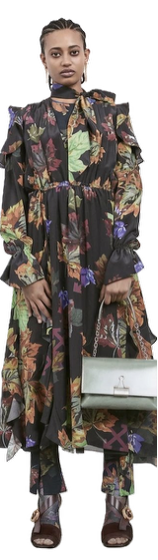
Digital Catapult joined Manchester's UKRI-funded research as technology and delivery partner, tasked with proving one idea: an archival garment, brought back to life as an immersive cyber-physical experience.
The garment: an Off-White Pre-Fall 2020 silk maxi dress.
As Technical and Creative Director, I designed the experience end-to-end. From the technical architecture and AI tool stack to the creative concept.
Technology
Meta Quest 3- Mixed reality headset
Volumetric capture- Video recording movement and textures in 3D
Gaussian splatting- Photorealistic 3D model rendering technique
Concept
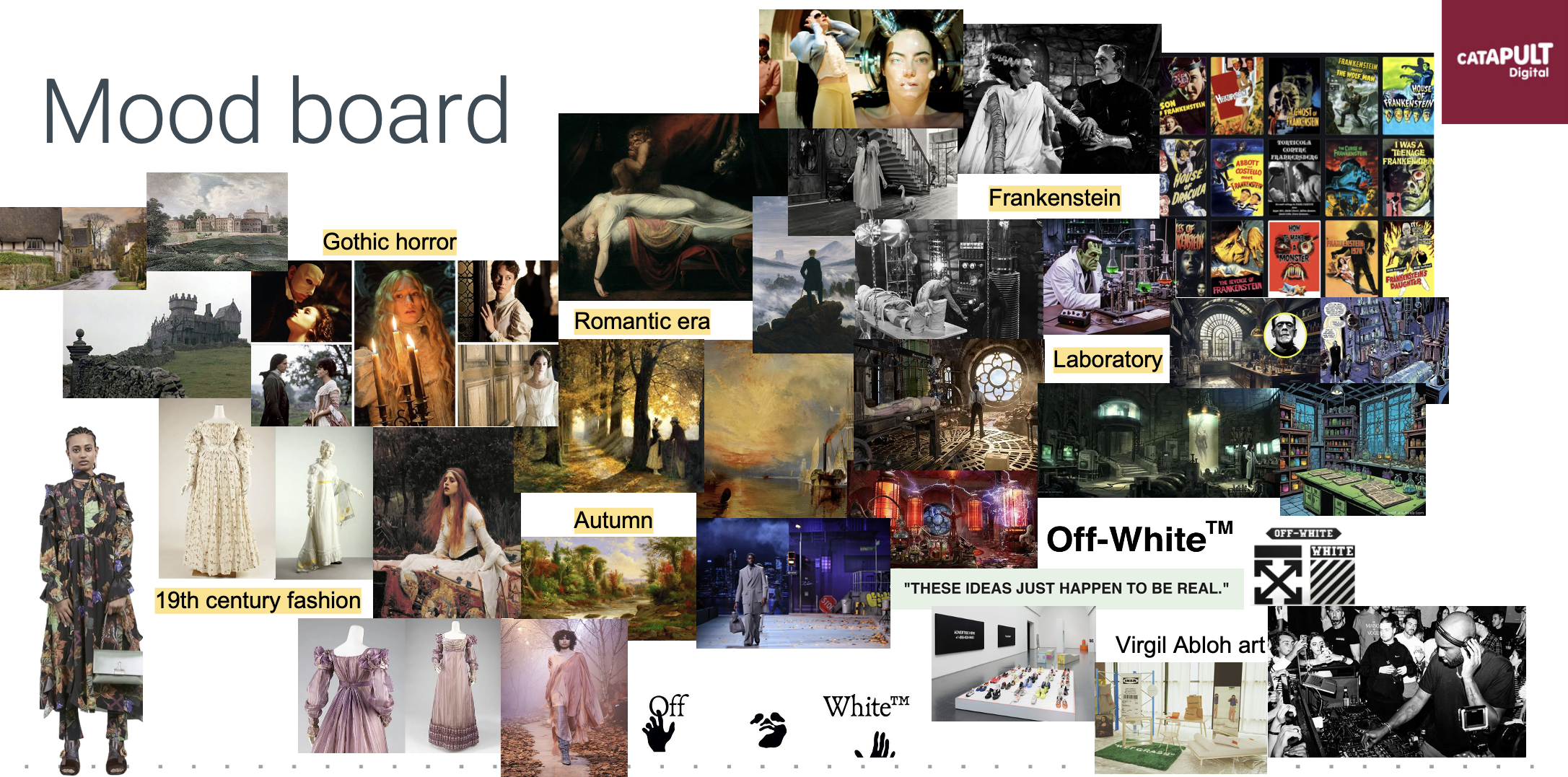
The experience takes place in a Frankenstein-style laboratory, both a nod to the 19th century Romantic references within the dress itself, and to Virgil Abloh's history of sampling and altering something existing to create something new.
The dress is positioned as the sum of its parts- print, construction, brand. And we find these within specimen jars and under microscopes, rather than body parts.
Our protagonist is newly "born," discovering her own body inside the dress at the same moment the audience does.
Post-production mirrors Abloh's DJ background- the clips of our model freeze, stutter, and layer rather than cut cleanly, giving the piece the feel of something almost human, but not quite.
The deliverable
A proof of concept built for private exhibition: A screen walks you through a 3D world at a distance setting the scene, then as you put on the headset along with others beside you, a photorealistic woman appears in the physical space in front of you. She moves around this space theatrically and as she comes closer to you, you see the finer details of this iconic dress.

An immersive dance-theatre experience about losing touch with yourself.
When you arrive, someone will fit you with a device. It goes around your torso. You're told it's for your health — government mandated, nothing to worry about. Around you, the world is in crisis. Just follow the instructions.
Tethered is a promenade dance-theatre experience set in a near-future where wearable technology has been deployed to monitor and regulate the human body. As you move through the show, the device you're wearing pulses and vibrates in response to what's happening on stage — syncing you to the inner lives of two characters living with early-onset dementia, triggered by the technological apocalypse, whose hold on memory and self is becoming harder to keep.
Objects pass between performers and audience throughout. Each one carries the weight of someone's memory. Each exchange is an act of connection in a world that has quietly made connection harder.
But not everyone's device is the same. And not everything you've been told about it is true.
Tethered fuses physical theatre, dance, live music and haptic wearable technology to explore what it means to trust or distrust your own body. It asks who benefits when we stop listening to ourselves, and what we might reclaim when we start again.
This is a show you watch, feel and make choices inside. Some of those choices are small. One of them isn't.

The piece feels like a living work of modern art that brings the audience into the construction.
It would not be out of place in an exhibition room at the MoMA or Tate Modern.
An admirably thoughtful experiment in movement and space.
I led the experiential and creative R&D direction of Tethered, defining how performers and audiences would interact within a multi-sensory, immersive performance environment. Working from an existing script, I focused on translating narrative themes into embodied audience experience rather than rewriting story or dialogue.


A key part of this was assigning the audience an active role within the world of the piece, ensuring they were not passive observers but embodied participants whose presence helped flesh out the performance's internal logic and world-building. I designed the interaction framework through which audiences inhabited this role, shaping how gaze, proximity, and spatial positioning created moments of intimacy, tension, and recognition between performers and audience members.
Objects played a central role in this approach — selected and deployed as memory carriers, allowing audiences to physically hold, witness, and transfer meaning through material interaction.
Alongside this, I developed a proof-of-concept integrating haptic wearable technology into the narrative of the performance, exploring how sensory feedback could function as an additional experiential layer that deepened audience embodiment and emotional resonance without overriding the live performance.
Debuted at 93 Feet Live, London.
Edinburgh Fringe Festival 2025.
Ongoing development.


Steven Bamidele's debut concept album THE CRASH! begins with a man — faithless, directionless, drifting through life until a spaceship crash lands in his living room. From the wreckage, a woman alien emerges, and through their relationship, meaning re-enters the world.
The album carries this narrative in abstraction — gestured at, never stated. My role as creative director was to make the allegory inhabitable and place the audience inside it.

The evening is divided into two acts — a live podcast (Vinyl Resting Place Pod Q&A) and a live musical performance. Rather than treating these as separate segments, I conceived them as two phases of a single theatrical journey.
Act I — The Living Room
The audience enters a fully staged living room. I decided the podcast Q&A should take place within the domestic world — the before. Towards its close, a theatrical crash sequence is staged and the audience are rushed to evacuate. This moment of displacement mirrors the unnamed character's rupture. His world is broken open. The audience does not yet know what they will return to.
Act II — The Crash
The audience returns to find the room transformed. Projection mapping floods the walls and the movement artist moves through the space as the woman alien — the source of all magic. Steven performs a curated selection from CRASH!, the visual world responding to the emotional arc of each song: cold and colourless in disconnection, saturated and alive when the characters draw close.
To brief the projection mapping artist and movement artist with precision, I designed a structured prompt sheet for Steven — a series of questions developed to draw out the narrative, visual, and emotional vocabulary of the album. Questions ranged from the broad (themes of liminal space, faith, connection) to the granular (how do people physically move through this world? what elemental forces exist that we have no concept of?).
This document became the shared creative compass for all three collaborators. From it, I extracted a world-building framework: two-state colour logic, the importance of blue as the colour of meaning, the Romeo-and-Juliet shape of the central relationship, and the core visual principle that the alien's presence should be felt rather than depicted literally.
I am currently producing a stimulus sheet for the projection mapping artist, developing prompts that translate the album's emotional architecture into visual sequences for the walls of the venue.
Industrial Digital Twins are typically designed for engineers — dense, data-led, screen-bound. The brief was to ask a different question: how do you translate a working industrial simulation into an experience that is legible, compelling and spatially present for a non-technical audience of stakeholders, decision-makers and national policymakers? I led the concept development and early-stage design of the immersive experience, defining how immersive and multi-sensory systems could be layered onto the existing Digital Twin to create something you could step inside rather than observe from a screen.
A visitor puts on a virtual reality headset. The room disappears. They are standing inside a running factory, not watching it from a screen. And they can press buttons in the digital VR experience, which will start/stop the real life factory conveyor belt.
I led the concept development and early-stage design of the experience, defining how immersive and multi-sensory systems could be layered onto the existing Digital Twin to create something you could step inside rather than observe from a screen.
This required working simultaneously across three registers: the technical architecture of the simulation itself; the spatial and sensory logic of the immersive experience; and the interaction design that would allow a non-specialist visitor to navigate and understand a complex industrial system in real time.

System architecture — authored by Rachel Thuo
My original Digital Twin project had secured £XXk+ in follow-on funding, scaling into a larger multi-disciplinary team and expanding the scope and ambition of the work beyond the initial R&D phase.
The Digital Twin was showcased at the National Digital Twin Centre launch as a national benchmark for immersive innovation in industry — demonstrating how experiential design thinking can make complex technology not just accessible, but genuinely compelling.
The full technical documentation — covering system architecture, VR integration, haptic glove setup, troubleshooting protocols and a user manual — was authored as part of this project.


The original Digital Twin was a single-user, single-location experience. The question I brought to the concept development of the enhanced version was: what if geography itself was a design material?
Using Gaussian splatting — a volumetric capture technique that reconstructs real spaces as photorealistic, navigable 3D environments — we proposed capturing Digital Catapult's offices in London, Belfast and Newcastle and placing them inside a single shared virtual world. Three cities. One step apart.
The experience was room-scale: visitors could physically walk through the virtual space, their real movement translating directly into the digital environment. And through the VR interface, a user standing in Belfast could reach into the London environment and interact with the physical CP Factory machine — triggering real change in a physical object hundreds of miles away.
The digital and physical were no longer separate systems. They were continuous and almost indistinguishable.
The National Digital Twin Centre launch had an audience of policymakers, industry leaders, academics and press. The experience had to communicate the ambition and significance of the technology without explanation. It had to speak for itself, spatially.
The goal was to create the feeling of standing at a threshold — between the world as it is and the world the technology makes possible.
Tunnel Groove was the second event in an evolving immersive nightlife series exploring how sound, space, and visual illusion can reshape collective experience. Building on the first iteration — which fused live saxophone with a techno DJ set — this version shifted tone into a funky house–led experience, inspired by the visual language of funfairs, crazy houses, and playful perceptual distortion. Set within tunnel environments in central London, the event aimed to reframe nightlife as an immersive, world-led experience rather than a conventional club format.

I led the project end to end, originating the creative concept and translating it into a cohesive, multi-sensory world designed to be playful, disorienting, and participatory. I chose to use Projection Mapping on the walls of the tunnel, engulfing the audience to reach this effect.
I shaped the event across all touchpoints: creating the visual mood boards; collaborating with a projection mapping artist to realise the environment; curating the musical identity by sourcing DJs and defining set concepts; and physically configuring the space to support audience flow and collective atmosphere. I also created the event's dynamic poster with Adobe Creative Suite and authored the marketing copy, ensuring the public-facing narrative aligned with the internal logic of the experience.

Tunnel Groove was conceived as an experimental yet repeatable format rather than a one-off event. The success of this second iteration demonstrated how the core concept could be adapted and evolved over time, allowing each edition to explore a distinct aesthetic and musical identity while retaining a consistent experiential structure.
The series began with Techno Tunnel Rave — a techno DJ set fused with live saxophone and an immersive art installation inside the COLAB Tower tunnel, July 2025.

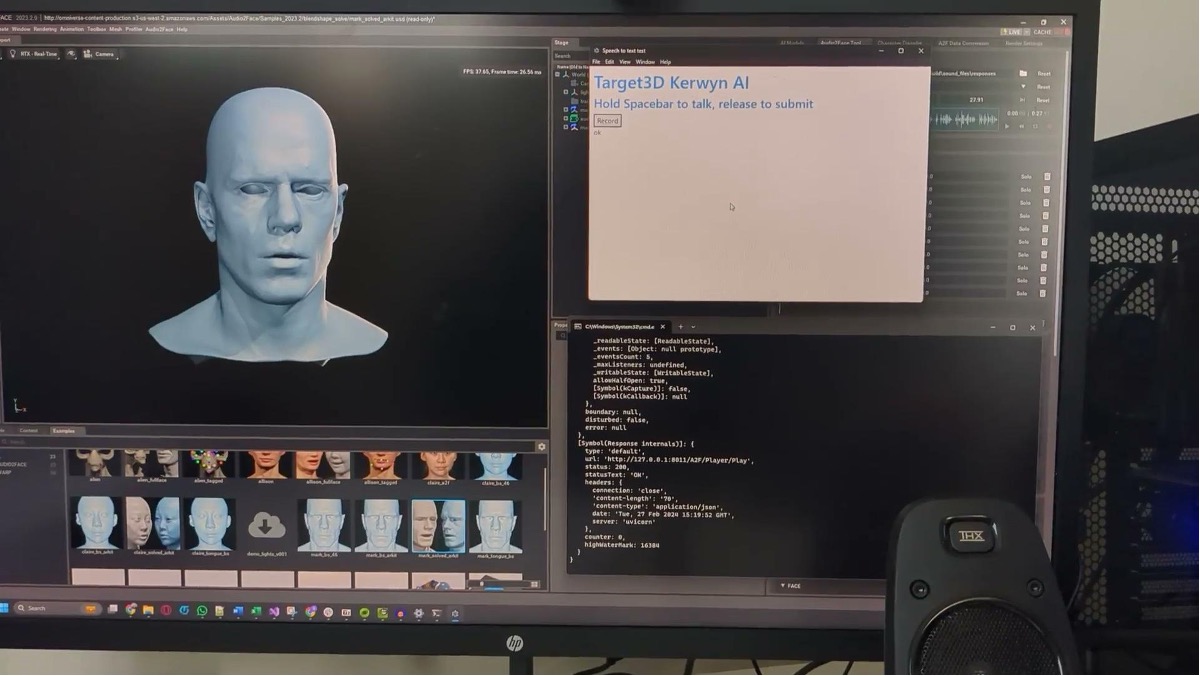
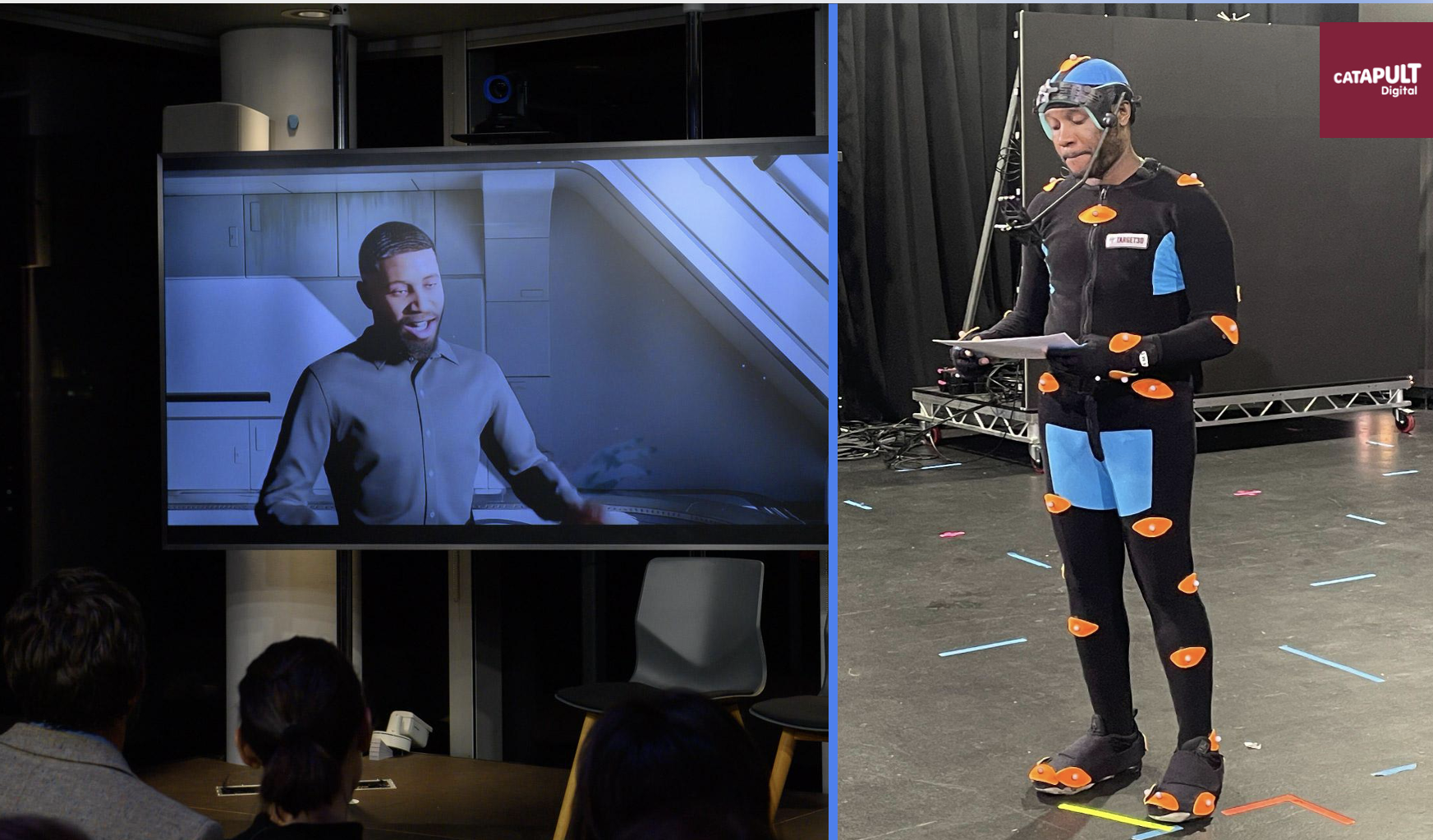
Digital Catapult's investigation into ethical AI within the creative industries, developed in partnership with Target3D and Hat Trick Productions.
Ahead of the technical sprint, I designed and delivered exploratory workshops investigating hyper-realistic digital characters as a way to examine digital identity, representation, and presence. Working hands-on with Unreal Engine's MetaHuman Creator as a creative tool, I helped establish the visual and experiential language that later informed the direction of the project.
Upon receiving funding to create a demonstration, I conducted research into the real-world challenges and tensions surrounding ethical AI in the creative industries. Rather than informing the AI system's underlying knowledge (which drew on large language models), my findings were translated into training and guidance materials published alongside the experience, supporting organisations to engage critically and responsibly with the use of AI.
My focus was on ensuring the experience functioned not just as a technical showcase, but as a meaningful point of engagement — helping audiences and organisations grapple with the lived, emotional, and ethical realities of AI in practice.
Debuted at SXSW Texas 2024.